
It’s a little foggy as to when I determined to start practicing laughing like my Aunt Vera, though I was certain at the time I must attempt to give it substantial effort. It was just the best. I coveted her ways. So practice I did.
But you don’t need to tell anyone . . .

Her face, underneath a crown of bronze curls, would simultaneously redden, crinkle around the edges, and rise almost imperceptibly from her shoulders as the rest of her body stiffened in an effort to contain what was potentially an impressive roar of laughter. Silence would win the day every time though, her visible inner battle making me wonder a time or two if she might implode on the spot. If everyone else in the room was guffawing uncontrollably at a scene or a joke, a glance in Vera’s direction might reveal a trickling tear or two leaking surreptitiously out the corners of her eyes. A couple times I thought I detected a wheeze but that may just be family legend. Pure artistry. Genius. I wanted that.
Vera had – in my kid/teenager opinion – a personal shellac, a control, that was opposite from my dramatic, easy-to-cry persona. Oh to be like her.
This oldest sister of my dad’s lived far from us most of my life but she may as well have been just down the hall for the kinship I felt when her name was mentioned. And since her story is not completely mine to tell, I won’t attempt to try and do it in total or perfectly. These thoughts of mine are filled with bits of conjecture from the stirred pot of tales told during my upbringing along with honest reality thrown in from actual interaction, especially by the time I became an adult. There are admittedly gaps. One thing I do know without a doubt is that as a kid who could feel homesick just being down the street, I was comfortable and so satisfied in her presence that none of that “missing home” business crossed my mind. That’s a bar few could claim to reach.
Never a fan of Rice Chex cereal, I became one when she gave me a bowlful at their kitchen table in Port Angeles, Washington after we’d arrived from a long day of travel. Nowadays there are few things more cozy than a bowl of Rice Chex. (Okay, okay, so my tastes are not exactly high bred.) Wait, were they Wheat Chex? Ugh. Now I have to buy both.
Born at home in 1924, Vera Mae Keen must’ve (though there’s no one living to verify it) hit the scene knowing what to do, what to say, what she wanted, and how to bend the underlings to her will. She deeply loved, intensely interacted, and didn’t put up with … well, because this is not a cuss-word blog … stuff.
When the two of them were together my dad would call her “Veer.”
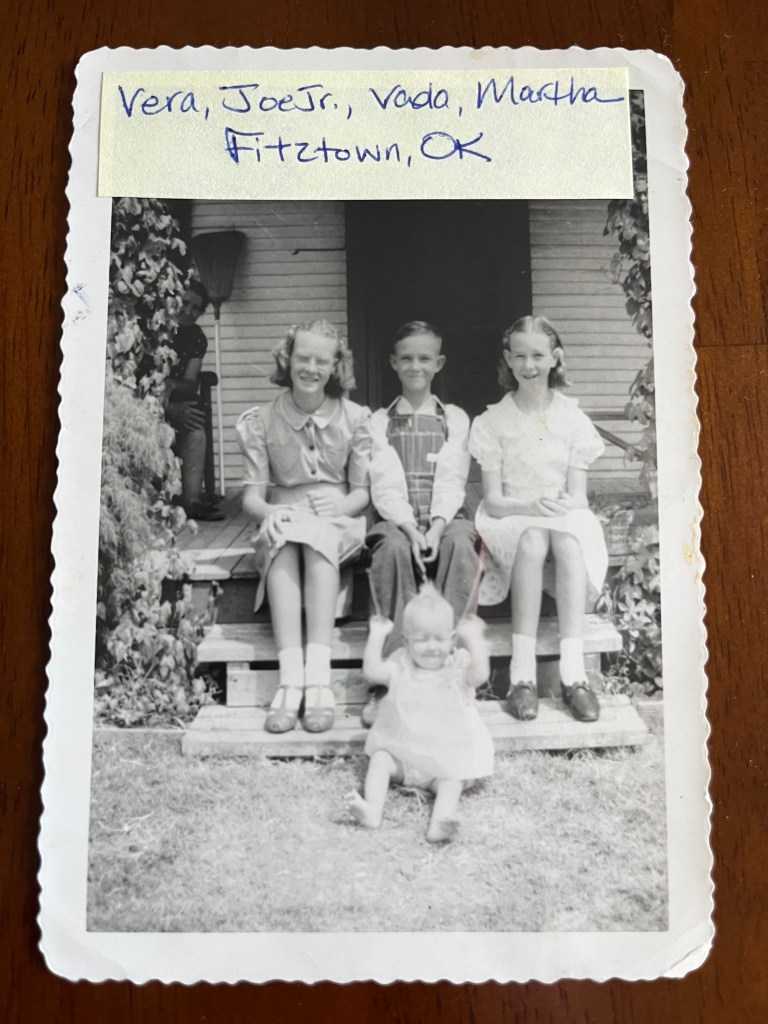


Vera Keen Landers


As the eldest daughter in a family who pulled up stakes in Oklahoma during the Dust Bowl and traveled to pick fruit on the west coast just to make it from one day to the next, Vera must’ve borne a certain amount of responsibility. I wish I could ask her about that. I think she’d tell me anything I wanted to know, within reason, but she was never one to volunteer any, “Boy howdy, we had it rough,” types of stories just to make a point. She’d seen things. Lived through things. Watched folks with a far easier life than she’d had, complain. And in response she’d add another coat of shellac. Without responding.
She was a teenager when she married Dalton Landers – 16 I believe. Their children came along, a girl and two boys. Dalton, along with his brother Doyle (who would marry Vera’s sister, my Aunt Vada), both fought in the European theater of WWII and came home. Both brothers then worked long careers for Crown Zellerbach paper and pulp mills in the Pacific Northwest.
The decades when Vera was raising her children are a big blank for me. I was quite a bit younger than my cousins, the daughter of her only brother, and not old enough to be aware of life apart from my own limited orbit. However, I would hear little dribbles of stories that led me to believe there might have been some challenging times, especially as the daughter and two sons entered their teens. No criticism here, I was a Tasmanian devil myself (please see Looney Tunes). Families go through stuff. They did. We did. And here we are.
Both her boys were invited by Uncle Sam to the war in Vietnam. They both went. They both came home. Sounds simple. Wasn’t. Not for them and not for their families.
Vera was acquainted with grief. A grandson died suddenly as a young adult. One son was lost at sea and declared dead after significant time had passed. She outlived all her siblings and her husband. She was in the hospital room with me when my dad, her brother, died. At his bedside she declared that, “He was my best friend.” And there she stood as solid as a rock at age 76 while I had to sit down.
I’m not so sure she and I would’ve done as well as mother and daughter as we did aunt and niece. Her red-headed temperament and staunch positions about church this-and-that would’ve butted right up against the same red-headed genes in me (though the color never manifested itself) and my I’m-Ok-You’re-Ok perception of the world could simply not have quietly existed alongside her. Yet she dearly loved me and I her. Though I don’t remember a specific conversation about the topic, I do recall the feeling that our puzzle pieces, hers and mine, clicked together more easily when I came to a saving knowledge of Christ at age 18. We began speaking the same language. I had come home.
I look to memories of my Aunt Vera when I wonder if what I’m doing or saying or not doing or not saying is enough to display my faith to my children and grandchildren, nieces, nephews, neighbors across the fence, and folk I have no idea are watching. The answer to that is never clear, but there’s a space reserved in my head for the music. The singing. The scenes of it. The pulling of lyrics and tunes and harmonies straight from experience rather than from relying on notes on a page (usually). Where there was Vera and Joe there was singing. If there was a piano my mom played. Depending on how many men, women, and children were in the room, there you would have the choral backup group. If you didn’t know the song, hang around long enough and you would . . . they often had 5+ verses and they sang ’em all.
If that’s not a beautiful representation of faith I don’t know what is. Songs speak volumes of peace and hope when the spoken word and finger wagging (Lord, forgive us) backfire. Music can be tucked away. Repeated when needed. Taken on road trips and walks around the block. Handed down through generations.
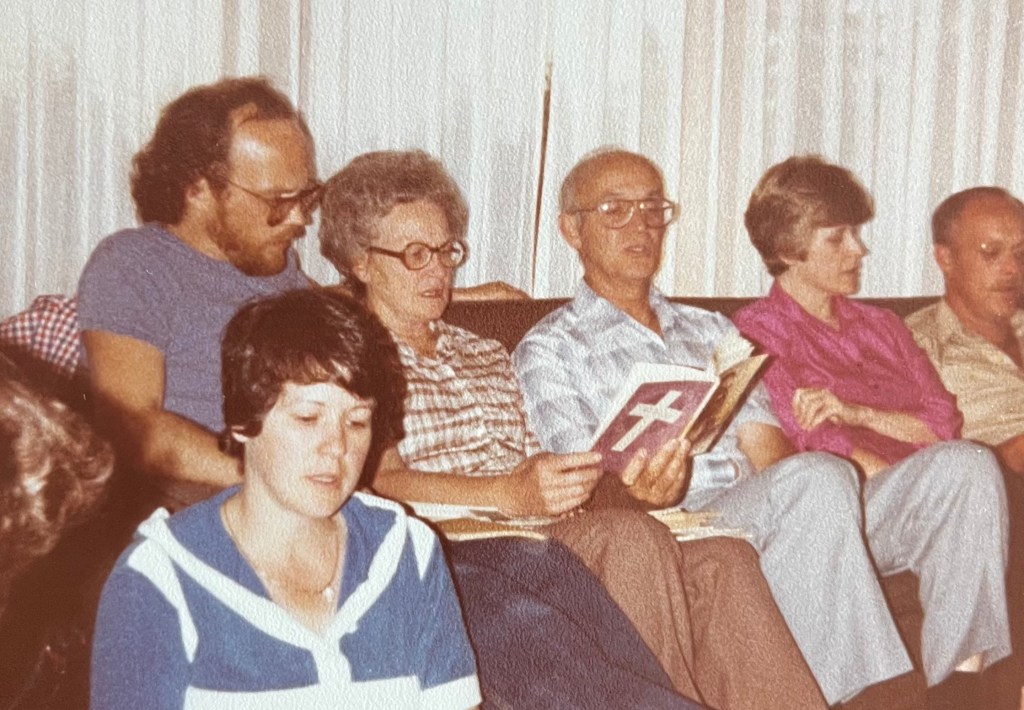
“Kneel at the Cross” was a golden oldie Joe and Vera were known for. They sang it at least once at every family gathering. Their distinctive voices fit together, both pounding out their respective melodies and harmonies as if they’d done it 10,000 times before. Which might not be a stretch.
Here’s an O.L.D. version of that song I found. Other recordings I tried were worse — too banjo-y or nasal or too slow or too fast or too dumb. You get what you get on YouTube. So don’t laugh at it. It’s necessary for this space. Maybe it might sound familiar to a few of you:
One more thought about the couch sing-alongs with Vera . . . there were places she and her siblings, Joe and Vada, couldn’t go emotionally, though they’d give it a shot once in a while. They could not get through the hymn, “Precious Memories” because of missing their parents and all the feelings that the words stirred up. I watched them try a few times but they crumbled after a line or two and called it off. No doubt the memories were far too precious for mere words. I get that.
There’s way more about my Aunt Vera that I don’t know than I do.
What my memories perceive is a small percentage of who she really was. But isn’t that true of most of our relationships? I know there are mighty few people on earth who truly know me. Genuinely truly get it. Yet we still owe it to those who influence us for the better, whether we know every aspect of their lives or not, to expose the good, the strong, the earnest and the true about them. If we can.
She was strong. In her faith. In her opinions. And in her determination.
She loved children and was proud of her grands and great grands.
She did not suffer fools.
She could make a comfortable home out of unusual and different situations. All of them non “homesicky.”
She was on my side. That counts for a lot.
In her later years, after the vitality and the red hair and the clarity had faded, she needed help. She found it in her daughter. Did she always know or appreciate the dedication and the one-foot-in-front-of-the-other mentality it took to watch over her during those last years? Nope. But that’s what we do isn’t it? Our old ones cared for us. We do it for them. Generations.
For those with a high need to know, I never perfected my Aunt Vera laugh. Gave it up decades ago. I’m a hopelessly loud, shocking cackler who can easily be picked out of a crowd. While it’s good to keep goals in mind, it’s also freeing to just let go and make folks around you jump out of their skin when something strikes you funny. As Popeye would say, “I yam what I yam.”
Much love,
MM
For the Lord is good and his love endures forever; his faithfulness continues through all generations.
Psalm 100:5
 Beyond Lashley Lane
4 responses to “Veer”
Another good one, Molly! I would have liked her, I am sure.😍
Sent from my Verizon, Samsung Galaxy smartphone
Get Outlook for Androidhttps://aka.ms/AAb9ysg
LikeLike
Not that my words are important BUT I can never get my comments to send. I enjoy your stories and your auntie sounds great. I 💘 love unique relatives. Miss you and Bob!LoisSent from my T-Mobile 4G LTE Device
LikeLike
I loved this one. Very accurate and honoring. Aunt Vera was easy to love!
LikeLike
I knew Vera, Molly, but not like you do. I love that you honor her with your remembrances. I must be about the only aunt you have left, and maybe you will write something about me after I am gone. On second thought, maybe it would be best to not write anything about me!
LikeLike